Ravin Penetration Testing for Deer and Elk Hunters
A crossbow that prints tight groups on a calm range day is only half the story. Ravin penetration testing matters because the job does not end when the bolt reaches the animal. For clean, ethical deer and elk hunting, you need enough penetration to reach vital tissue from the angles you are actually willing to take – not just impressive speed numbers on a box.
Ravin crossbows have earned their reputation with compact designs, high bolt speed, and a shooting system built around consistent bolt flight. That can translate into serious field performance. But penetration is not a single number, and no honest review should pretend that it is. Broadhead choice, bolt condition, shot angle, distance, animal size, and your own accuracy all matter as much as raw feet per second.
What Ravin Penetration Testing Really Measures
Good penetration testing is not about shooting random household junk and declaring a winner. Those videos can be entertaining, but foam blocks, plywood, plastic jugs, and ballistic gel each tell only part of the story. A hunting crossbow needs to drive a broadhead through hide, muscle, ribs when encountered, and vital organs. No test medium fully copies that combination.
The practical goal is to compare setups under repeatable conditions. Shoot the same Ravin bolt and broadhead combination at measured distances, then look at accuracy, broadhead flight, entry depth in a consistent target medium, and bolt or broadhead damage after impact. This does not predict an exact result on a whitetail or elk. It does show whether your setup is flying true and carrying enough practical momentum for the game you hunt.
Speed gets most of the attention because it is easy to market. It also helps flatten trajectory, which can make range estimation mistakes less punishing. Penetration, however, depends heavily on momentum, bolt mass, broadhead design, and energy retained downrange. A fast setup with a poorly tuned expandable broadhead can waste its advantage. A properly matched bolt and sharp, dependable broadhead gives a Ravin crossbow a better chance to do its job when the shot is right.
How Ravin Models Fit a Penetration-First Setup
The Ravin R10 remains a sensible choice for hunters who want a more approachable entry into the Ravin lineup. It has the compact handling and speed most deer hunters need without forcing them into the highest-priced package. For typical whitetail distances, a well-maintained R10 with the correct Ravin bolts and a proven hunting broadhead has plenty of capability. The limiting factor is more likely to be an angled shoulder shot than a lack of advertised speed.
The R29X pushes performance further for hunters who want more speed and a flatter trajectory while keeping the narrow Ravin platform. That extra performance can be useful in open country, elevated stands, or situations where a deer may step out farther than expected. It is not permission to take marginal shots. It is a margin of performance when your ranging, broadhead flight, and shot placement are already handled.
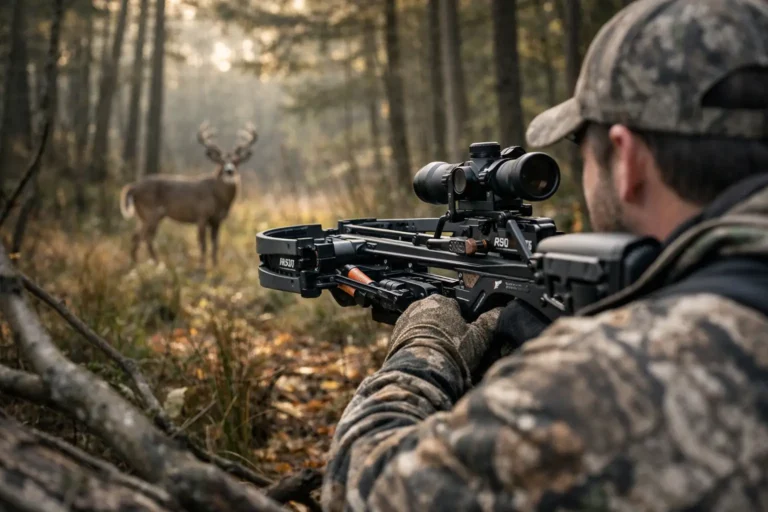
The Ravin R50 and R500 sit at the high-performance end of the conversation. Their speed can produce excellent bolt flight and quick arrival at the target, especially when paired with bolts in good condition. For elk hunters, those advantages are real, but they should be viewed correctly. An R500 does not turn a steep quartering-to angle or a shoulder-heavy impact into a smart shot. It gives a disciplined hunter a highly capable platform for broadside and mild quartering-away opportunities.
If you are comparing the R10, R29X, R50, and R500, start with your normal hunting distance and game size. Then factor in how much practice you will realistically do. The fastest Ravin is not automatically the best buy if its cost leaves no room for quality broadheads, replacement bolts, target time, and proper maintenance.
The Gear Choices That Change Penetration
A Ravin is a system, not just a crossbow. Changing one piece can affect broadhead flight, point of impact, and penetration. Use bolts that meet Ravin’s specifications for your exact model. Do not improvise with a bolt that merely appears to fit. Crossbows store substantial energy, and incorrect bolt selection can create accuracy problems, equipment damage, and safety risks.
Broadhead choice is where hunters often overcomplicate things. A fixed-blade broadhead generally offers a simpler, tougher profile and fewer moving parts. It can be an excellent option for hunters who want dependable penetration, especially for larger-bodied game. The trade-off is that fixed blades demand good tuning and confirmation at distance. If they do not hit with your field points, the problem needs to be solved before hunting season.
Expandable broadheads can provide a larger cutting diameter and may fly more like field points in some setups. The trade-off is added mechanical complexity and, depending on the design, more resistance through the animal. There is no universal winner. For deer at normal stand distances, a quality expandable that groups perfectly can be a sound choice. For elk, many hunters lean toward a strong fixed-blade design, but the right answer still depends on what your Ravin shoots accurately and what the manufacturer approves for crossbow use.
Sharpness is not optional. A dull broadhead can turn an otherwise capable R29X, R50, or R500 into a poor performer. Inspect every edge, replace damaged blades, and never hunt with a broadhead that struck a hard target unless you have checked it carefully.
A Practical Way to Test Your Ravin Setup
Before season, test the actual setup you intend to carry into the woods. Do not sight in with field points, buy broadheads the night before opening day, and assume they will land together.
- Start at 20 yards with field points, then shoot your broadheads from the same stable position. If the groups do not match, fix the issue before moving back.
- Confirm at 30, 40, and your personal maximum hunting distance. For many deer hunters, that maximum should be the farthest range where every bolt stays in a confident vital-zone group under realistic conditions.
- Use the same bolt model, nock style, and broadhead weight throughout testing. Mark bolts and retire any with cracks, damaged nocks, loose components, or questionable straightness.
- Practice from the positions you hunt. A bench proves mechanical accuracy. Kneeling, seated, and elevated practice show whether you can make the shot when your pack, clothing, shooting lane, and nerves are part of the equation.
For penetration media, use a quality crossbow-rated target built to stop broadheads, following the target maker’s guidance. Compare bolt entry and removal resistance only when the target is in similar condition. Do not shoot broadheads into targets that are not rated for them, and do not use hard objects as a penetration test. You can ruin expensive Ravin bolts, damage broadheads, or create a dangerous ricochet.
Shot Angle Still Beats Speed
The cleanest setup in the world cannot fix poor anatomy or a bad angle. Broadside and mild quartering-away shots give the broadhead its best path through the chest cavity. On deer, that usually means waiting for the near-side shoulder to move forward and aiming for the heart-lung area. On elk, patience matters even more because the animal is larger, the margins can feel smaller, and recovery can become much harder if the hit is not solid.
Avoid treating high-speed Ravin models as an excuse to force a quartering-to shot through the shoulder. Heavy bone is a bad bet, regardless of the speed rating. Also account for angle from an elevated stand. Aim for the exit path through the chest, not simply the visible entry point on the near side.
A complete pass-through is desirable because it can leave a better blood trail, but it is not the only measure of a lethal hit. A bolt lodged in the far side after passing through both lungs can still be a successful result. The priority is a sharp broadhead through the vitals, followed by a disciplined wait and careful tracking plan.
Buy for the Hunt You Actually Take
Ravin penetration testing should make your purchase decision clearer, not more complicated. The R10 can be a strong deer-hunting tool for the buyer who values practical performance and budget control. The R29X makes sense for hunters wanting more speed without jumping to the top tier. The R50 and R500 are built for hunters who want premium compact performance and will put in the practice needed to use it well.
Use the Ravin comparison page before buying to match speed, size, package details, and price to your hunting style. Then spend as much care choosing approved bolts, a hunting-ready broadhead, and enough practice time to prove the setup. Real survival info. Real gear. No BS. The best Ravin for you is the one you can shoot accurately, maintain properly, and trust when a clean shot finally appears.