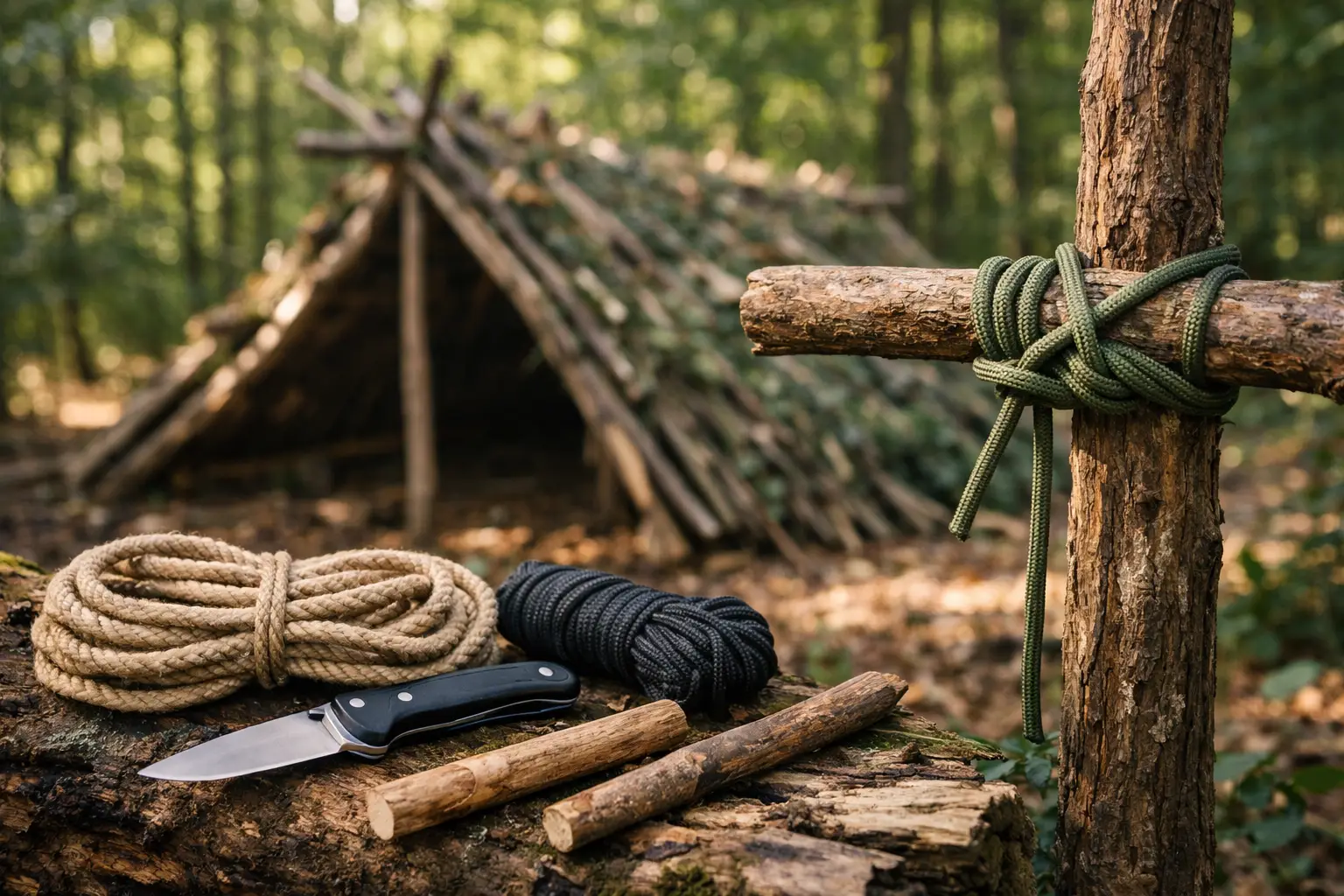
7 Best Knots for Survival Shelter
A shelter usually fails at the same two points – bad cordage or bad knots. If your tarp sags, your ridgeline slips, or your stake-outs pull loose in wind, knowing the best knots for survival shelter setup matters a lot more than owning fancy gear. A few simple knots, tied well and used in the right place, will do more for a fast, dependable shelter than a bag full of gimmicks.
This is not about learning twenty knots you will forget by next weekend. For real-world shelter work, you need a short list that covers ridgelines, stake-outs, tensioning, joining line, and quick-release options when weather or daylight is working against you.
The best knots for survival shelter work
If you only learn seven knots, you can build most tarp shelters, debris shelters, emergency lean-tos, and improvised covers without much trouble. The key is matching the knot to the job instead of forcing one knot to do everything.
A good shelter knot should do one of three things well. It should create a secure loop, grip under load, or let you adjust tension without retying the whole system. Some knots are stronger but harder to untie after rain and heavy load. Others are easy to adjust but can slip if tied carelessly or used with slick cord. That trade-off matters.
1. Bowline
The bowline is one of the most useful knots in survival because it makes a fixed loop that stays stable under load. For shelter building, that loop gives you a clean anchor point around a tree, branch, or stake.
Use it at the end of a ridgeline or whenever you need a non-slipping loop. It is especially useful when setting a tarp between two trees because you can wrap the line around a trunk and keep a solid loop without choking the cord tight.
The downside is simple – if you do not dress it properly, it can work loose over time, especially with stiff or slippery cordage. For beginners, that means practice matters. Once you get it down, it earns a permanent spot in your kit.
2. Taut-line hitch
The taut-line hitch is one of the first adjustable knots most people should learn. It slides when you want it to, then grips when tension is applied. That makes it ideal for tarp guy lines and stake-out points.
If your shelter starts sagging after rain or temperature changes, this knot lets you retension the line fast without rebuilding the whole setup. That alone makes it one of the best knots for survival shelter use in the real world, where cord stretches and weather shifts.
Its weak point is slick cord. On basic utility cord or paracord, it works well. On very smooth synthetic line, it may not hold as confidently as you want. In that case, a trucker’s hitch or a better quality line tensioner setup may be the smarter move.
3. Trucker’s hitch
If you want a tight ridgeline, learn the trucker’s hitch. This knot system gives you mechanical advantage, meaning you can pull a line far tighter than you could with a basic wrap and tie-off.
For tarp shelters, this matters because a tight ridgeline sheds rain better, flaps less in wind, and gives your whole structure more shape. A loose ridgeline turns a shelter into a wet, noisy mess in a hurry.
The trucker’s hitch takes a little more effort to learn than a taut-line hitch, but it is worth it. It shines when you need real tension across a ridgeline or when using larger tarps that catch more wind. The trade-off is that beginners sometimes overcomplicate it. Keep it simple: make your loop, run the working end through, pull tight, and lock it off cleanly.
4. Clove hitch
The clove hitch is fast, simple, and handy for starting a tie around poles, branches, or stakes. If you are building a frame-style shelter or lashing a crosspiece onto a support, this knot gives you a quick way to get started.
It is not the strongest knot on this list when used alone under shifting load. That is the honest truth. But speed matters in shelter building, and the clove hitch is excellent as a starting knot for lashings or for temporary positioning before you reinforce with something better.
Think of it as a work knot, not a miracle knot. It is useful because it is fast, not because it solves every problem.
5. Sheet bend
Sometimes your shelter line is too short. Sometimes one piece of cord gets damaged and you need to add another section. That is where the sheet bend comes in.
This knot joins two lines together, even if they are different thicknesses. That can be useful in an emergency when your cordage is a mix of paracord, bank line, and whatever else is in your pack, truck, or van.
For shelter use, the sheet bend is better than trying to force a square knot into a job it was never meant to do. It is dependable, fairly easy to learn, and especially useful when improvising. If you expect heavy load or wet conditions, dress it carefully and leave enough tail.
6. Prusik knot
The Prusik knot is less common for total beginners, but it is extremely useful on a ridgeline. It grips when loaded and slides when unloaded, which makes it ideal for adjustable tarp attachment points.
A lot of solid tarp setups use a fixed ridgeline with Prusik loops to move the tarp left or right and fine-tune tension. That gives you better control than tying directly to the ridgeline every time.
This is one of those knots that feels more advanced than it really is. Once you understand it, you start seeing how practical it is for repeat shelter setups. If you camp, hunt, or spend time off-grid, it can save time and frustration.
7. Siberian hitch
The Siberian hitch is a fast way to anchor a line to a tree, especially when you want a quick-release option. In cold, wet, or low-light conditions, speed matters. This knot is popular because it can be tied quickly and untied quickly.
It works well as the first anchor point for a ridgeline. Pair it with a trucker’s hitch on the opposite end, and you have a strong, efficient shelter setup that handles most tarp jobs well.
The main reason to learn this knot is efficiency. If you are setting shelter in rain, fading daylight, or gloves, a quick anchor knot is worth more than a complicated one you can barely remember.
How to choose the best knots for survival shelter setups
The right knot depends on the shelter style, the cord you are using, and the weather you expect. A small lean-to in mild weather does not need the same knot system as a large tarp in wind and cold rain.
For a basic tarp between two trees, a Siberian hitch or bowline on one end and a trucker’s hitch on the other gives you a solid ridgeline. For guy lines, a taut-line hitch keeps adjustments easy. If you are attaching gear or tarp points to a fixed ridgeline, Prusik loops are a smart upgrade.
If you are building a debris shelter with a branch frame, clove hitches help with quick lashings. If you need to extend cordage, use a sheet bend instead of making a weak mess with a random overhand knot.
The bigger point is this: shelter knots are not about showing off knot knowledge. They are about staying dry, saving time, and reducing failure points when conditions get ugly.
Cordage matters as much as the knot
Even the best knot will fail with junk cord. Cheap line frays, stretches too much, or slips when wet. Slick synthetic cord can also make some adjustable knots less reliable if you do not tie and dress them properly.
For most beginners, a quality paracord or utility cord is enough to learn on. Bank line is another strong option for shelter work because it grips well and packs small. If you are building out a real shelter kit, keep a mix of cord lengths instead of one giant bundle. That gives you more flexibility for ridgelines, guy lines, repairs, and backup use.
This is also where gear starts to matter. A decent tarp with reinforced tie-outs and dependable cordage makes every knot work better. Dark Justice Survival focuses on gear that holds up in the real world for exactly this reason – skill matters, but bad equipment creates avoidable problems.
Practice these knots before you need them
You do not need to become a knot expert. You do need enough repetition that your hands know what to do when it is cold, wet, and getting dark.
Practice with the actual cord and tarp you plan to carry. Tie a ridgeline in your yard. Set up a lean-to at camp. Adjust lines after they get wet. That kind of repetition teaches more than memorizing diagrams ever will.
A good rule is simple: if you cannot tie it under pressure, it is not really part of your kit yet. Learn a few knots, use them often, and build your shelter system around what you can tie fast and trust when weather turns bad.
The best shelter knot is the one you can tie correctly every time, with gear that will not quit when you need it most.