Best Portable Solar Panels for Camping Hunters
A dead phone at a remote deer camp is annoying. A dead GPS, headlamp battery, or rangefinder the night before a long walk to the stand is a real problem. The best portable solar panels for camping are not necessarily the biggest or most expensive ones. They are the panels that can keep your actual hunting electronics running without taking over your truck bed or requiring perfect weather.
For crossbow hunters, solar power is an accessory system, not a replacement for common sense. Your crossbow does not need a panel, but the gear around the hunt often does: navigation, communication, lighting, trail cameras, rechargeable lanterns, and a power station for a multi-day camp. Real survival info. Real gear. No BS.
What Makes the Best Portable Solar Panels for Camping?
Start with output, but do not stop there. A panel advertised at 100 watts rarely produces 100 watts all day in the woods. Clouds, tree cover, panel angle, heat, dirty surfaces, and a low sun all cut production. Treat the printed wattage as a best-case ceiling, not a promise.
For a weekend hunt where you need to top off phones, GPS units, headlamps, and a battery bank, a folding 40- to 60-watt panel is often enough. For a base camp with several hunters, a power station, rechargeable lights, and trail-camera batteries, 100 watts is the more practical starting point. A 200-watt folding setup makes sense when you are staying longer, running more gear, or hunting from a vehicle-based camp where space and weight are less of a concern.
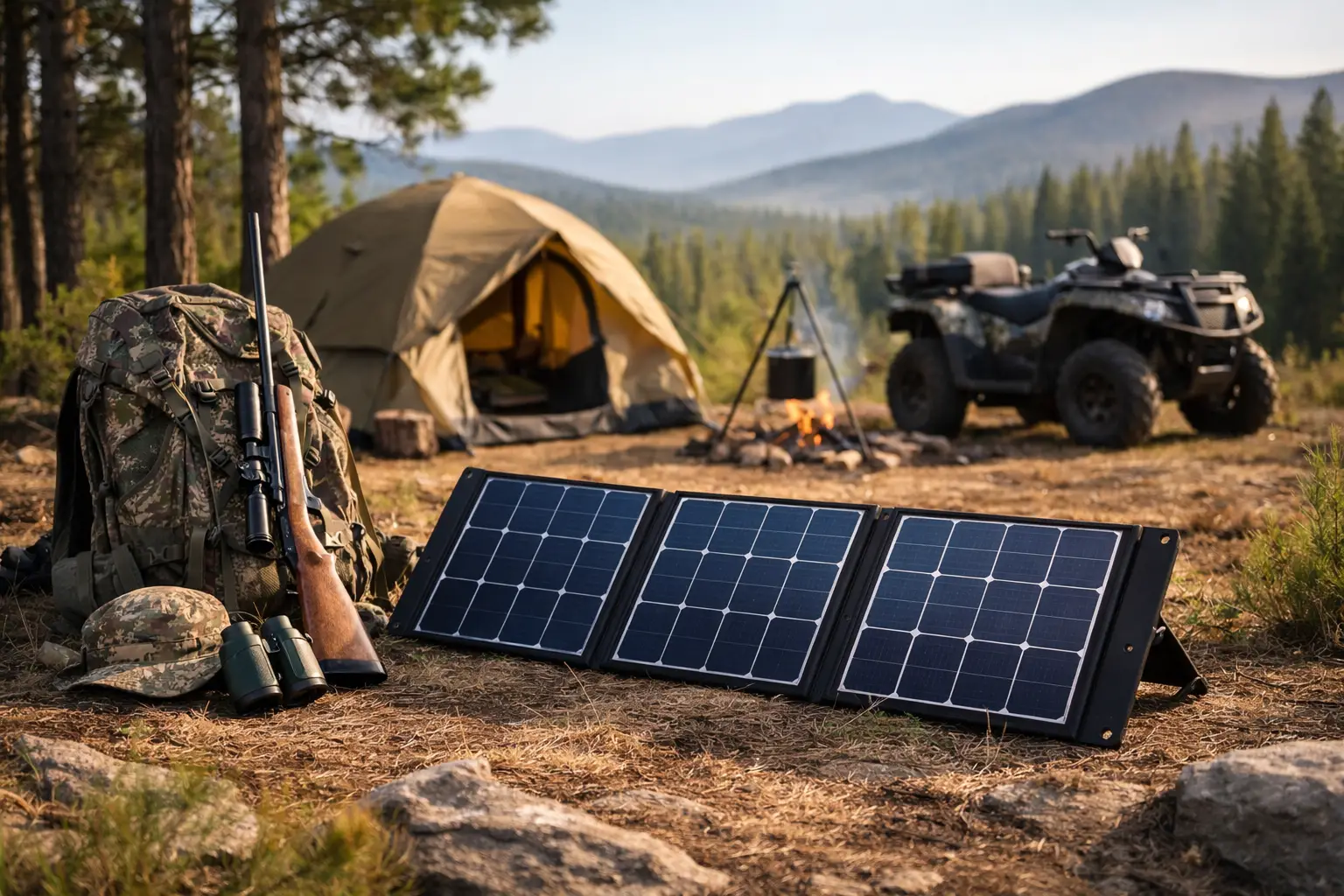
Portability matters as much as wattage. A panel that stays in the truck because it is bulky, awkward, or slow to deploy is not useful. Look for a folding design with a sturdy handle, solid kickstands, protected corners, and a cable long enough to put the panel in sun while the battery sits in shade. That last part matters. Heat is hard on battery packs and power stations.
The panel is only half the system
A solar panel needs somewhere to send its power. Some small panels include USB outputs for charging a phone or headlamp directly, but direct charging can be inconsistent when clouds pass or the panel shifts. For hunting camp use, pairing the panel with a quality battery bank is usually smarter.
For larger setups, use a compatible power station with a built-in charge controller. The controller manages the incoming solar power and protects the battery. Check the panel’s connector, voltage range, and maximum input rating before buying. A mismatch can leave you with expensive gear that will not charge.
Do not assume every portable panel works with every power station. Confirm the specifications before the trip, then test the full system at home. If the connectors need an adapter, pack the adapter with the panel instead of tossing it loose into a gear tote.
Choose Panel Size by Your Hunting Camp
The right panel depends on the kind of camp you run. A backpack hunter has different needs from a group sleeping out of wall tents near a trailhead.
Light-and-mobile camp: 40 to 60 watts
This is the practical range for one hunter carrying minimal electronics. It can recharge a phone, GPS, headlamp batteries, and a modest battery bank during a reasonably sunny day. It is also easier to move as the sun changes and easier to pack around other hunting gear.
The trade-off is charging speed. A 60-watt panel will struggle to refill a large power station after a cloudy day, especially under a forest canopy. Buy this size for personal electronics, not for running a full camp.
Weekend truck camp: 100 watts
For many deer and elk hunters, this is the sweet spot. A 100-watt folding panel offers enough capacity to replenish a mid-size power station, handle several phones and lights, and keep battery banks ready for early starts. It is still manageable enough for one person to set up and store.
This is also the sensible category if you use electronic accessories around a Ravin crossbow setup, such as a phone running ballistic notes, a rangefinder with a rechargeable battery, or a compact work light for organizing gear after dark. The panel is supporting the hunt, not adding clutter to it.
Extended group camp: 200 watts or more
A bigger panel is for bigger electrical demands. Think multiple hunters, a long stay, frequent device charging, brighter camp lighting, or a larger power station. A 200-watt setup can recover from heavy use faster, but it takes more room, costs more, and is more annoying to reposition as the sun moves.
If your camp is mostly under mature timber, bigger is not automatically better. A large panel in deep shade produces very little. In that situation, a smaller panel that you can carry to a sunny opening with a long cable may outperform the oversized option sitting beside the tent.
Features Worth Paying For
Camping panels get tossed into trucks, leaned against rocks, and used in wind. Flimsy kickstands and weak corner stitching are not small issues. They are the difference between a panel producing power and a panel face-down in the dirt.
Prioritize a weather-resistant surface, reinforced hinges, stable kickstands, and protected connection ports. Water resistance is useful, but it does not mean you should leave electrical connections exposed during a hard rain. Dry the panel before folding it away, especially after muddy or wet conditions.
A built-in display can be helpful because it shows whether the panel is actually producing useful power. Still, do not pay a major premium for screens and extra ports if the panel construction is questionable. Durability, output compatibility, and a realistic size for your camp come first.
Cable length deserves more attention than most buyers give it. A short cable forces you to keep the battery in direct sunlight beside the panel. A longer cable lets you place the panel in a clearing while keeping charging gear under cover, out of sight, and cooler.
Setup Rules That Prevent Bad Results
Solar panels work best when they face the sun directly, not when they are tossed flat on the ground near camp. Set up early, aim the panel toward the strongest sun, and adjust it once or twice during the day if charging speed matters. In the Northern Hemisphere, a south-facing placement is usually the starting point.
Keep pine needles, dust, snow, and leaves off the panel surface. Even partial shade can drag down output far more than most people expect. One shaded section of a folding panel can affect the entire setup.
Charge your power station or battery bank before leaving home. Solar should extend your available power, not carry the entire load from zero. This matters most during overcast weather, short winter days, and heavily wooded hunts.
Keep electronics organized in a dry pouch or hard case. Use the panel only during daylight, then bring the battery bank into the tent, truck, or secure storage at night. Leaving small electronics outside invites moisture, theft, and unnecessary gear loss.
Common Buying Mistakes
The biggest mistake is buying based on advertised wattage alone. A cheap high-watt claim means little if the panel has weak materials, poor connectors, or no usable way to charge your existing battery system.
Another mistake is expecting solar to run high-draw appliances at camp. Portable panels are excellent for communication, navigation, lighting, cameras, and modest power stations. They are not magic. If you need to run heaters, cooking appliances, or other heavy loads, you need to calculate battery capacity and daily power use honestly.
Finally, do not buy a panel without testing it before the hunt. Connect every cable, adapter, battery bank, and power station in your driveway. Check charging speed in sunlight. Learn what the indicator lights mean. A remote camp is the wrong place to discover that a connector does not fit.
The best camping solar setup is the one that quietly keeps your hunting essentials ready while you focus on wind, access, and the shot ahead. Buy for your real power needs, test it before the season, and keep the system simple enough that it earns its space in camp.