Crossbow vs Compound Bow Hunting for Real Hunters
A buck steps into a narrow opening, pauses for three seconds, and starts moving again. That moment exposes the real difference in crossbow vs compound bow hunting. One platform lets you shoulder a cocked, scoped weapon and settle the shot. The other rewards the hunter who has built enough form, strength, and repetition to draw smoothly without being seen. Neither is automatically better. One may be a better fit for how you actually hunt.
For the hunter who wants practical capability with less time spent maintaining traditional archery form, a crossbow is usually the clearer choice. For the hunter who values light carry weight, fast follow-up opportunities, and the full challenge of archery, a compound bow still earns its place. Real gear. Real trade-offs. No BS.
Crossbow vs Compound Bow Hunting: The Core Difference
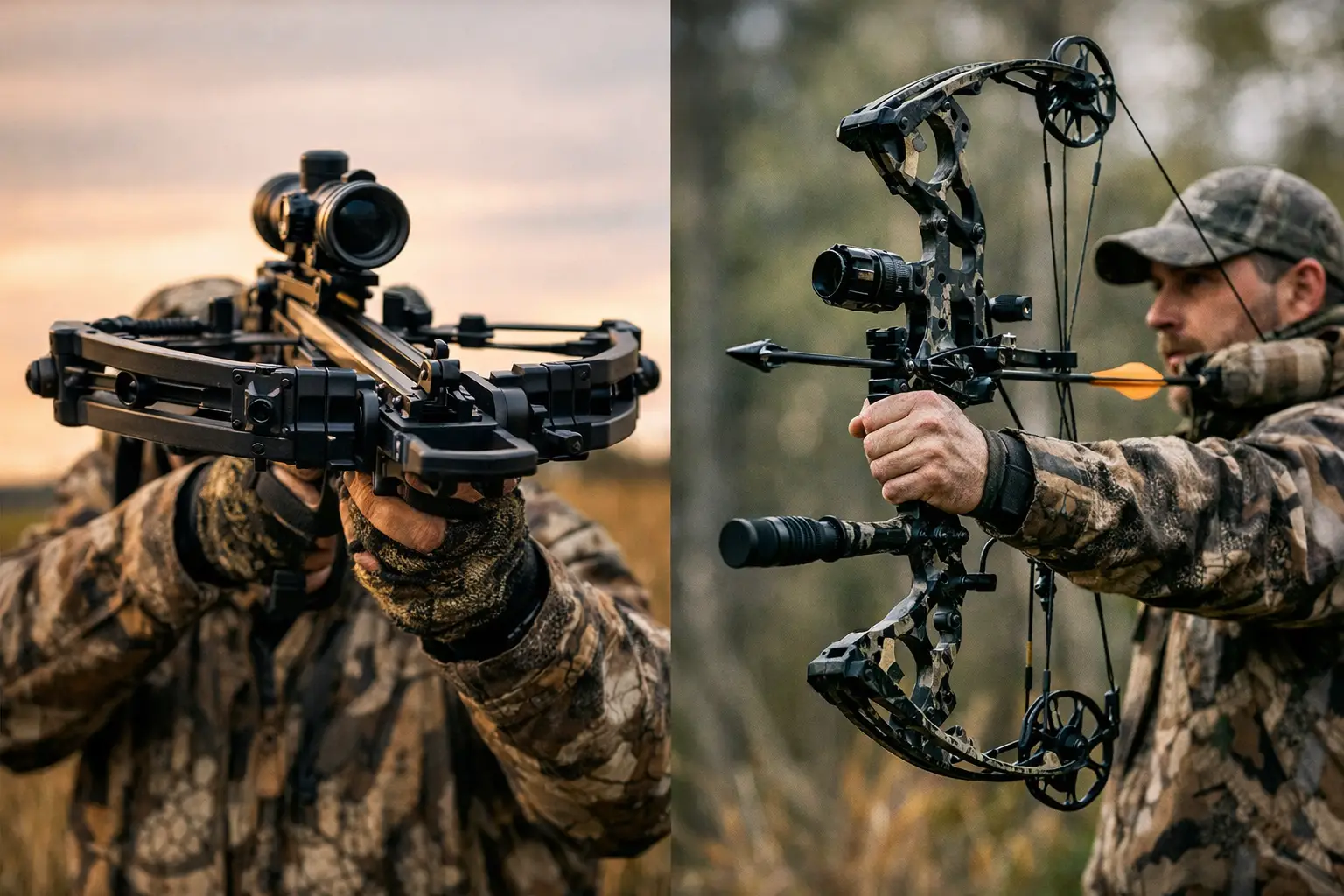
A crossbow stores its energy before the shot. You cock it, load a bolt, engage the safety, and carry it ready to fire. When an animal presents a shot, you shoulder the crossbow, use the optic, and press the trigger. The difficult physical act of drawing has already happened.
A compound bow stores energy only when you draw it. Even with high let-off, you must draw the bow at the right time, hold your form, establish an anchor point, aim, and release cleanly. That takes practice. It also takes composure when a deer is close and your heart rate is up.
That does not make a crossbow effortless. It makes the shot sequence more familiar to many new hunters, especially people with rifle experience. You still need range time, broadhead tuning, a stable rest or shooting position, and the discipline to pass shots beyond your proven range.
Why a Crossbow Fits More Hunters
The biggest advantage is practical accuracy under pressure. A quality crossbow with a dependable scope gives hunters a clear aiming reference and a stable shoulder-fired position. That can reduce the learning curve, particularly for adults coming back to hunting after years away or newcomers who do not have months to build consistent compound-bow form.
Crossbows also help hunters with shoulder injuries, reduced upper-body strength, or limited mobility. Drawing a compound bow from a seated blind, on a cold morning, or while twisted in a tree stand can be difficult. With a crossbow, the strenuous part is handled before the animal arrives. Some hunters use a cocking device or crank system to make that process more manageable, though it still requires care and attention.
Ravin crossbows are built around this kind of real-world use. Their compact layouts and reverse-draw designs are especially useful in blinds and tight stand setups, where wide limbs can snag on walls, rails, or brush. Ravin models are also known for speed and precision-focused engineering, but speed is not the reason to buy one by itself. The useful benefit is a flatter trajectory that can make distance estimation errors less punishing inside your ethical, practiced range.
If you are comparing models, start with the Ravin comparison page and look at overall length, axle-to-axle width when cocked, weight, cocking method, and the optic package. Do not buy based on feet per second alone. A crossbow you can cock safely, carry comfortably, and shoot consistently is the one that belongs in your hunting setup.
The Crossbow Trade-Offs
Crossbows are not magic deer machines. They are usually heavier and more awkward to carry than compound bows. A crossbow can feel bulky on a long walk, and it needs a sling, case, or secure hanger system to keep it under control. In a tree stand, you will often need a haul rope and a solid way to rest or hang it.
Reloading is also slow. After the shot, you must cock the crossbow, load another bolt, and make sure everything is properly seated. A compound bow is faster to nock and draw for a second opportunity, assuming you have room and the animal has not already left.
Noise matters too. A crossbow’s shot can be sharp, and fast bolts do not erase an animal’s ability to react. Keep shots close, know your equipment, and do not confuse advertised speed with a license to stretch range. The animal deserves better than that.
Where a Compound Bow Still Has the Edge
A compound bow is lighter in the hand and easier to carry through rough ground. It can be a better tool for hunters covering miles, slipping through timber, or still-hunting where every branch and shoulder strap matters. Its narrow, upright profile also moves naturally through cover.
The compound bow’s other major advantage is readiness after movement. A hunter can nock an arrow quickly and remain mobile without managing the bulk of a cocked crossbow. In a spot-and-stalk situation, that can matter. So can the ability to make a quiet, controlled draw when the moment is right.
But this advantage comes with a price: you have to earn it. Consistent compound-bow hunting requires regular practice, not a few arrows the week before season. You need to know your draw weight, draw length, anchor, release, sight picture, and effective range. If your groups fall apart after 20 or 30 yards, that is not a gear problem. It is a signal to shorten your shots and train more.
For many hunters, the compound bow is less about convenience and more about participation. The draw, the close distance, and the constant demand for clean form are the point. If that is what makes hunting meaningful to you, a crossbow should not be forced into the role.
Pick the Platform That Matches Your Hunt
Choose a crossbow if you hunt mostly from ground blinds or tree stands, want a scoped aiming system, have physical limits that make drawing difficult, or want to shorten the path from first practice session to dependable field accuracy. A Ravin crossbow is worth serious consideration if compact handling, speed, and refined build quality matter in your setup.
Choose a compound bow if you enjoy archery practice, prioritize light carry weight, hunt on the move, and are willing to build the muscle memory needed to draw and shoot well under stress. A compound bow can be an excellent hunting tool, but only when its owner treats practice as part of the hunt rather than an optional extra.
Your local regulations are part of the decision, too. Crossbow seasons, legal equipment rules, broadhead requirements, discharge restrictions, and transportation rules vary by state and sometimes by hunting unit. Check the current regulations before buying gear or assuming that an archery-season tag allows every archery platform.
Accuracy Is Earned at the Range
Whatever you carry, establish a personal maximum range based on field-style practice, not bench-rest confidence. Shoot from a seated position, standing position, kneeling position, and the type of elevated or blind setup you use during season. Practice with the broadheads you plan to hunt with, because field points alone do not prove that your hunting setup is ready.
With a crossbow, inspect bolts, nocks, strings, cables, and the rail before every outing. Never dry-fire it, never use damaged bolts, and keep fingers below the flight deck when shooting. With a compound bow, inspect the string, cables, cams, limb condition, rest, and arrow shafts. Both platforms can cause serious injury when handled carelessly.
The right choice is the one that lets you make calm, repeatable, ethical shots where you hunt. If a compact Ravin crossbow gets you practicing more and hunting with more confidence, that is a practical reason to use one. If a compound bow keeps you committed to the discipline of close-range archery, carry it proudly. The animal does not care what platform you chose. It cares whether you make the shot count.